
How Google Handles Hreflang Clusters Internally
Hreflang does not rank pages by itself. It helps Google cluster localized URLs and show the right version to the right user. Here’s how the system works.
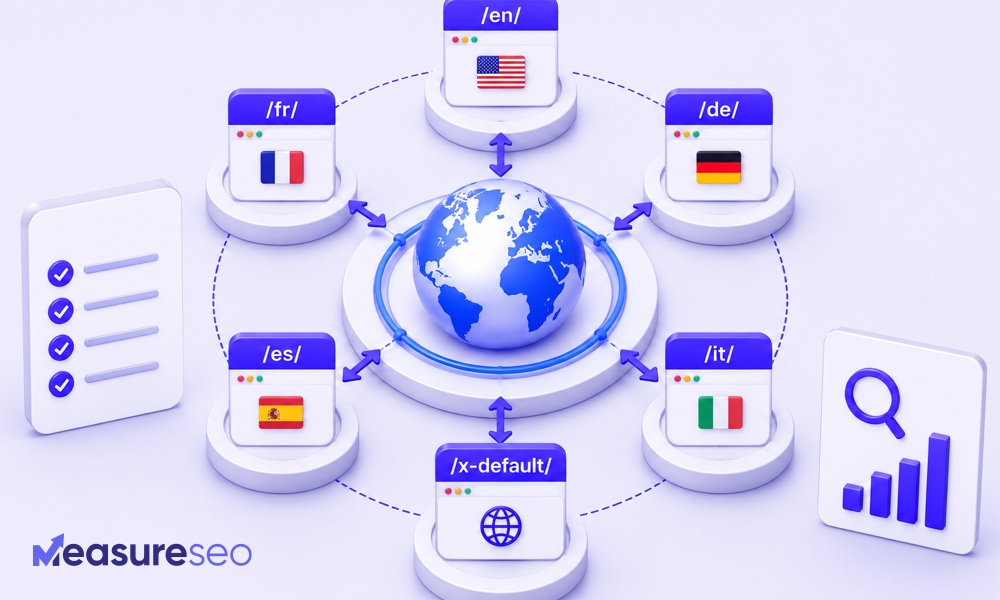
How Hreflang Clusters Work: The Internal Logic Behind Multilingual SEO
Core angle: Hreflang is not a ranking booster. It is a locale-routing system. It helps Google understand that a group of URLs are alternate versions of the same page.
1. Think of Hreflang as a Cluster, Not a Tag
Bad mental model:
This page has hreflang tags.Better mental model:
This page belongs to a locale cluster.Example cluster:
/en/pricing/
/fr/tarifs/
/de/preise/
/es/precios/
Each page should reference:
itself
every alternate version
optional x-default
Google’s documentation says each language version must list itself and all other language versions. It also says alternate URLs must be fully qualified. ([Google for Developers][2])
2. Example: Correct Hreflang Cluster
On every version of the pricing page:
<link rel="alternate" hreflang="en" href="https://example.com/en/pricing/" />
<link rel="alternate" hreflang="fr" href="https://example.com/fr/tarifs/" />
<link rel="alternate" hreflang="de" href="https://example.com/de/preise/" />
<link rel="alternate" hreflang="es" href="https://example.com/es/precios/" />
<link rel="alternate" hreflang="x-default" href="https://example.com/pricing/" />
The set should be identical across the cluster.
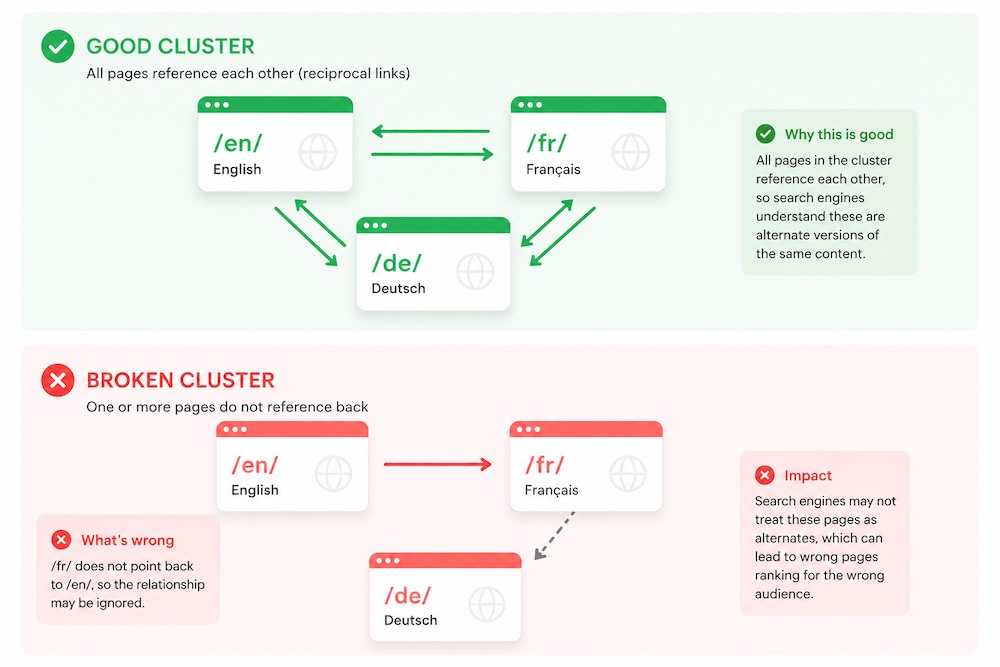
3. The Bidirectional Rule
If /fr/tarifs/ points to /de/preise/, but /de/preise/ does not point back, Google may ignore that relationship. Google explicitly says that if two pages do not both point to each other, the tags will be ignored. ([Google for Developers][2])
4. Hreflang Does Not Detect Language
This is a common mistake.
Google says it does not use hreflang or the HTML lang attribute to detect page language. It uses its own language detection algorithms. ([Google for Developers][2])
So this is not enough:
<html lang="fr">
<link rel="alternate" hreflang="fr" href="https://example.com/fr/" />
The visible content must actually be French.
5. Hreflang and Canonical Must Agree
Each localized page should usually canonicalize to itself.
Correct:
<!-- /fr/tarifs/ -->
<link rel="canonical" href="https://example.com/fr/tarifs/" />
<link rel="alternate" hreflang="fr" href="https://example.com/fr/tarifs/" />
<link rel="alternate" hreflang="en" href="https://example.com/en/pricing/" />
Dangerous:
<!-- /fr/tarifs/ -->
<link rel="canonical" href="https://example.com/en/pricing/" />
<link rel="alternate" hreflang="fr" href="https://example.com/fr/tarifs/" />
Google says when using hreflang, specify a canonical page in the same language, or the best substitute language if one does not exist. ([Google for Developers][3])
6. Common Hreflang Failure Modes
| Problem | What Happens |
|---|---|
| Missing self-reference | Cluster becomes less reliable |
| Missing return tag | Relationship may be ignored |
| Wrong canonical | Google may choose another URL |
Mixed http and https | Alternate mapping breaks |
| Relative URLs | Invalid implementation |
| Auto-redirecting users/bots | Google may not crawl all versions |
| Template translated, content not translated | Google may treat pages as duplicates |
7. Best Image Ideas
For these two articles, I’d create:
-
Architecture comparison graphic Three columns: ccTLD, subfolder, subdomain.
-
Hreflang cluster diagram Nodes connected by reciprocal arrows.
-
Canonical + hreflang flowchart “Does this page have a same-language canonical?” → yes/no.
-
Decision tree “Do you need legal/business separation?” → ccTLD. “Do you want shared authority?” → subfolder.
Strong Takeaway
Use subfolders by default. Use ccTLDs when the business is truly local-market-first. Use subdomains when infrastructure forces your hand.
For hreflang, stop thinking in tags. Think in clusters: every localized URL must agree about every other localized URL, while canonicals stay local.
Sources & References
The following resources were referenced throughout this article for hreflang implementation, multilingual clustering, canonicalization behavior, and international SEO architecture guidance.
-
Google Search Central — Managing Multi-Regional and Multilingual Sites
https://developers.google.com/search/docs/specialty/international/managing-multi-regional-sites -
Google Search Central — Localized Versions of Your Pages
https://developers.google.com/search/docs/specialty/international/localized-versions -
Google Search Central — How to Specify a Canonical URL
https://developers.google.com/search/docs/crawling-indexing/consolidate-duplicate-urls